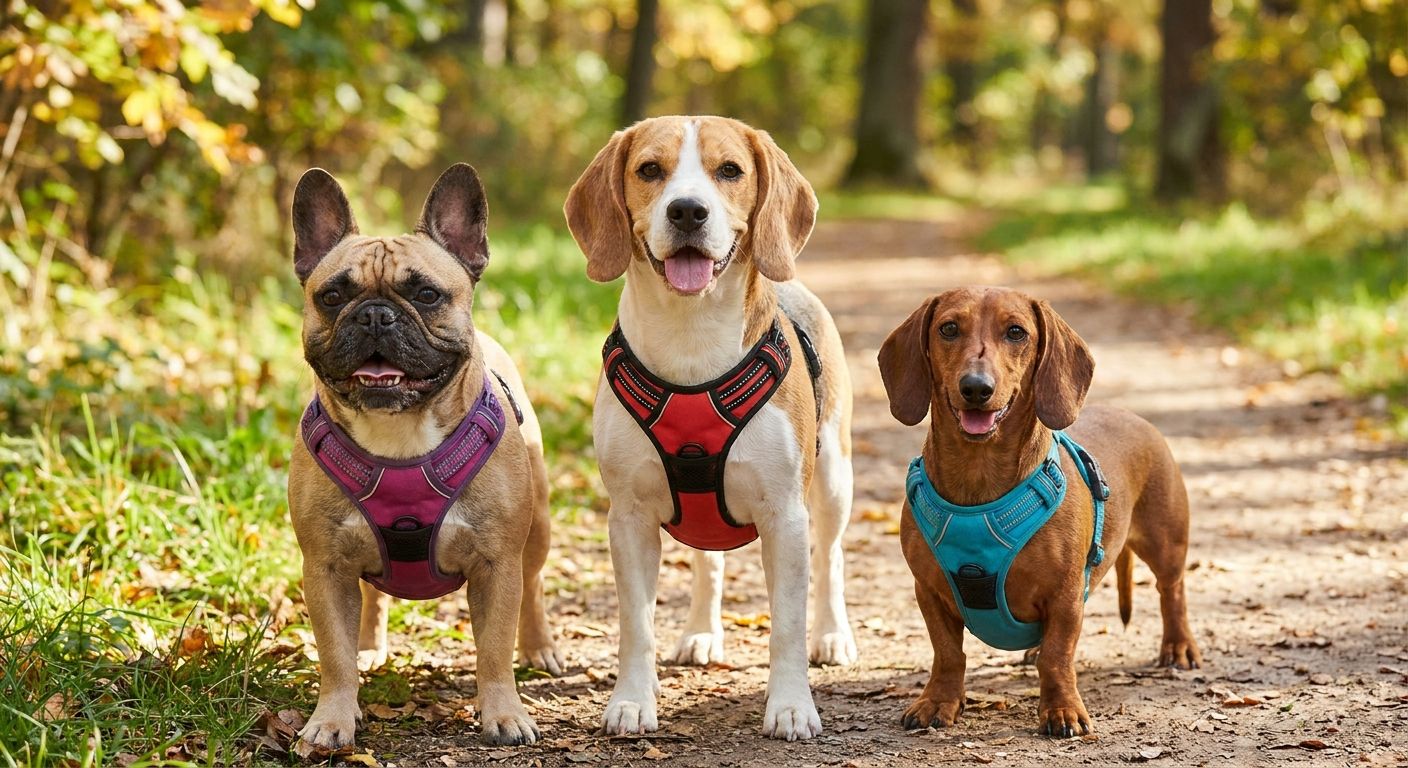
Small dogs get hurt by big-dog gear more often than most owners realise. A harness built for a Labrador's chest strap and clip placement puts pressure exactly where a Chihuahua, Cavoodle or Pug can least afford it — the trachea and the front legs.
- Y-front (H-style) harnesses are the best dog harness for small breeds overall in 2026 because they spread pressure across the chest, not the throat.
- Step-in harnesses suit nervous or arthritic small dogs that hate being dressed.
- Front-clip no-pull harnesses are the right pick for small breeds that lunge or pull on lead.
- Dual-clip padded harnesses protect small dogs prone to tracheal collapse or luxating patella.
- A correctly fitted harness should allow two fingers under every strap, not four.
Why this matters
Small and toy breeds carry two anatomical weak points that a poorly chosen harness makes worse: a narrower, more collapsible trachea, and a kneecap (patella) prone to slipping out of place. Vets across Sydney's Northern Beaches see both conditions regularly in breeds like Chihuahuas, Maltese, Cavoodles and French Bulldogs.
A collar concentrates every tug of the lead onto the neck. A well-fitted harness for a small breed moves that pressure onto the chest and shoulders instead — which matters far more for a 3kg dog than a 30kg one, because the margin for error is smaller. The team at Two by Two Veterinary Hospital checks harness fit as part of routine health checks for exactly this reason.
What makes the best small breed dog harness
- No throat pressure — the clip and straps sit across the chest and shoulders, never the trachea
- Escape-proof design — a strap behind the front legs plus a chest strap stops narrow-chested breeds like Whippets and Chihuahuas backing out
- Adjustable at 3+ points — small breeds vary hugely in chest girth even within the same weight class
- Breathable material — mesh or padded webbing matters in a Sydney summer when heat stress hits small, short-nosed breeds fastest
- Lightweight hardware — oversized D-rings and buckles drag on a 4kg dog's frame
- Back and front clip options — lets you switch between everyday walking and no-pull training without buying a second harness
Best dog harnesses for small breeds at a glance
| Harness type | Best for | Standout feature | Key limitation |
|---|---|---|---|
| Y-front (H-style) | Everyday walking, most small breeds | No pressure on the trachea | Slightly slower to put on than a vest |
| Step-in | Anxious, senior or arthritic small dogs | No overhead lifting required | Chest strap can ride up if loose |
| Front-clip no-pull | Small dogs that pull or lunge | Redirects the dog's body when it pulls | Not ideal as the only clip point on long walks |
| Vest-style | Sensitive skin, cold weather, brachycephalic breeds | Wide surface area spreads pressure further | Can trap heat in summer if not mesh |
| Dual-clip padded | Dogs with tracheal or joint sensitivity | Two clip points, extra padding at pressure zones | Bulkier fit on very small toy breeds |
1. Y-front (H-style) harness: best small breed harness for everyday walking
The Y-front design runs one strap down the chest and another around the ribcage, forming a Y or H shape that keeps every strap off the throat entirely. It's the closest thing to a universal recommendation for small breeds walking on the Northern Beaches, from the flat paths around Manly to the steeper streets near Balgowlah.
Y-front pros:
- Zero pressure on the trachea, even with a dog that pulls
- Full range of front-leg movement, unlike vest styles
- Works for both back-clip and dual-clip walking
Y-front cons:
- Takes two hands to fasten, which some dogs resist at first
- Loose adjustment lets a very narrow-chested breed twist it sideways
Best for: small breeds without a specific medical concern who need a daily, all-purpose walking harness.
Verdict: Buy. This is the default starting point for almost every small breed in 2026.
2. Step-in harness: best small breed harness for anxious or arthritic dogs
The dog steps into two leg holes and the harness clips up over the back — no lifting the dog's head or arms through loops. That single difference matters for a senior dog with sore joints or a rescue dog that panics at overhead handling.
Step-in pros:
- Fastest, lowest-stress way to dress a nervous dog
- No pulling straps over the head or ears
- Simple single clip on top, easy to reach quickly
Step-in cons:
- The chest strap can slide up toward the throat if it's even slightly loose
- Fewer adjustment points than a Y-front, so fit is less precise
Best for: older small dogs, rescues with handling anxiety, or any dog that fights harnesses that go over the head.
Verdict: Buy for the right dog — check the fit weekly since step-ins loosen with wear.
3. Front-clip no-pull harness: best small breed harness for lunging and pulling
Clipping the lead to a ring on the chest, rather than the back, means a pulling dog gets turned back toward the owner instead of dragging forward. Small breeds with big personalities — think Jack Russells and Fox Terriers — often pull harder relative to their size than large breeds do.
Front-clip pros:
- Reduces pulling without any pressure on the neck
- Useful training tool alongside loose-lead work
- Pairs well with a back clip for two-point control
Front-clip cons:
- Can cause the dog to walk slightly sideways until it adjusts
- Not the most comfortable option for a calm dog on a long, relaxed walk
Best for: small breeds that pull, lunge at other dogs, or need active leash training.
Verdict: Buy as a training harness; switch to Y-front once pulling improves.
4. Vest-style harness: best small breed harness for sensitive skin and cold weather
A vest harness covers more of the chest and belly than a strap-style design, which spreads pressure over a wider area. That extra coverage helps brachycephalic breeds like French Bulldogs and Pugs, which already carry a higher baseline risk of breathing difficulty.
Vest-style pros:
- Widest pressure distribution of any harness type
- Extra warmth for short-coated small breeds in winter
- Padded designs reduce chafing on dogs with sensitive skin
Vest-style cons:
- Non-mesh versions trap heat badly in a Sydney summer
- Harder to check for a correct fit once fully on
Best for: brachycephalic small breeds, dogs with skin sensitivity, or cold-weather walking.
Verdict: Buy in a mesh or ventilated version; skip solid vest fabric for summer walking.
5. Dual-clip padded harness: best small breed harness for tracheal or joint sensitivity
This style adds padding at the chest and shoulder plus two clip points — one on the back, one on the chest — so the lead attachment can change depending on the walk. It's the harness most often recommended for small dogs already diagnosed with a collapsing trachea or luxating patella, two conditions vets see frequently in toy breeds.
Dual-clip pros:
- Extra padding cuts pressure at exactly the point most small breeds are vulnerable
- Two clip options without switching harnesses mid-walk
- Suits dogs recovering from joint surgery who need controlled, gentle walking
Dual-clip cons:
- Bulkier fit than a slim Y-front, which matters on very small toy breeds under 3kg
- More straps mean more to check and adjust before every walk
Best for: small breeds with a diagnosed tracheal or joint issue, or seniors on joint supplements for ongoing support.
Verdict: Buy if your dog has a known joint or airway condition — ask your vet to confirm the fit at the next visit.
“If you can slide two fingers under every strap but not four, the harness is fitted correctly.”
How we ranked these
Each harness type is judged against the six criteria above: throat pressure, escape-proofing, adjustability, breathability, hardware weight, and clip flexibility. The Y-front sits at the top because it scores well on all six with no serious weakness; the other four each win a specific use case where the Y-front isn't the strongest option.
Get your dog's harness fit checked
Bring your dog's harness to a routine health check at Two by Two Veterinary Hospital.
Which small breed dog harness should you choose?
Start with a Y-front (H-style) harness if your dog has no diagnosed health issue — it covers the most walking scenarios with the least risk in 2026. Move to a front-clip no-pull design if pulling is the main problem, a step-in harness if dressing is the fight, and a dual-clip padded harness if a vet has flagged tracheal or joint concerns. Vest-style stays reserved for brachycephalic breeds and cold-weather walking rather than everyday use.
FAQ
What is the best dog harness for small breeds in 2026?
A Y-front (H-style) harness is the best all-purpose option for most small breeds in 2026 because it keeps pressure off the trachea while covering everyday walking needs. Dogs with a specific health issue often need a more specialised type, such as a dual-clip padded harness.
Is a harness better than a collar for small dogs?
Yes, a harness is generally safer than a collar for small breeds because it spreads leash pressure across the chest instead of concentrating it on the throat. This matters more for breeds prone to tracheal collapse, such as Chihuahuas, Pomeranians and toy poodles.
How do I know if a small dog's harness fits correctly?
You should be able to fit two fingers under every strap but not four, with no gap wide enough for the dog to back out. Check the fit again after a few weeks of wear, since straps loosen over time.
Can a harness stop a small dog escaping on walks?
A properly fitted harness with a strap behind the front legs and across the chest is much harder for a narrow-chested breed to back out of than a collar. It's not foolproof, so pairing it with a secure microchip registration adds a second layer of protection if a dog does slip free.
Do small dogs with a collapsing trachea need a special harness?
Yes, a dual-clip padded harness or a Y-front design keeps all pressure off the neck, which is the priority for any dog diagnosed with tracheal collapse. Ask your vet to check the fit at your dog's next visit if this has been diagnosed or suspected.
Are front-clip harnesses bad for small dogs?
Front-clip harnesses are not harmful for small dogs, but they're best used as a training tool for pulling rather than as the only harness for long, relaxed walks. Many owners switch between a front clip for training and a back clip for everyday walking.
How often should a small dog's harness be replaced?
Replace a harness once webbing frays, buckles loosen beyond adjustment, or the dog's weight changes enough to shift the fit. Check stitching and clips every few months, since small breeds put repeated stress on the same pressure points.
One last thing
Small breeds are overrepresented in tracheal collapse and luxating patella cases seen in general practice, which is exactly why harness choice carries more weight for a 4kg dog than a 40kg one. The single biggest fit mistake owners make in 2026 isn't the harness type — it's leaving the chest strap one notch too loose, which lets even a well-designed Y-front ride up toward the throat on a determined puller.