
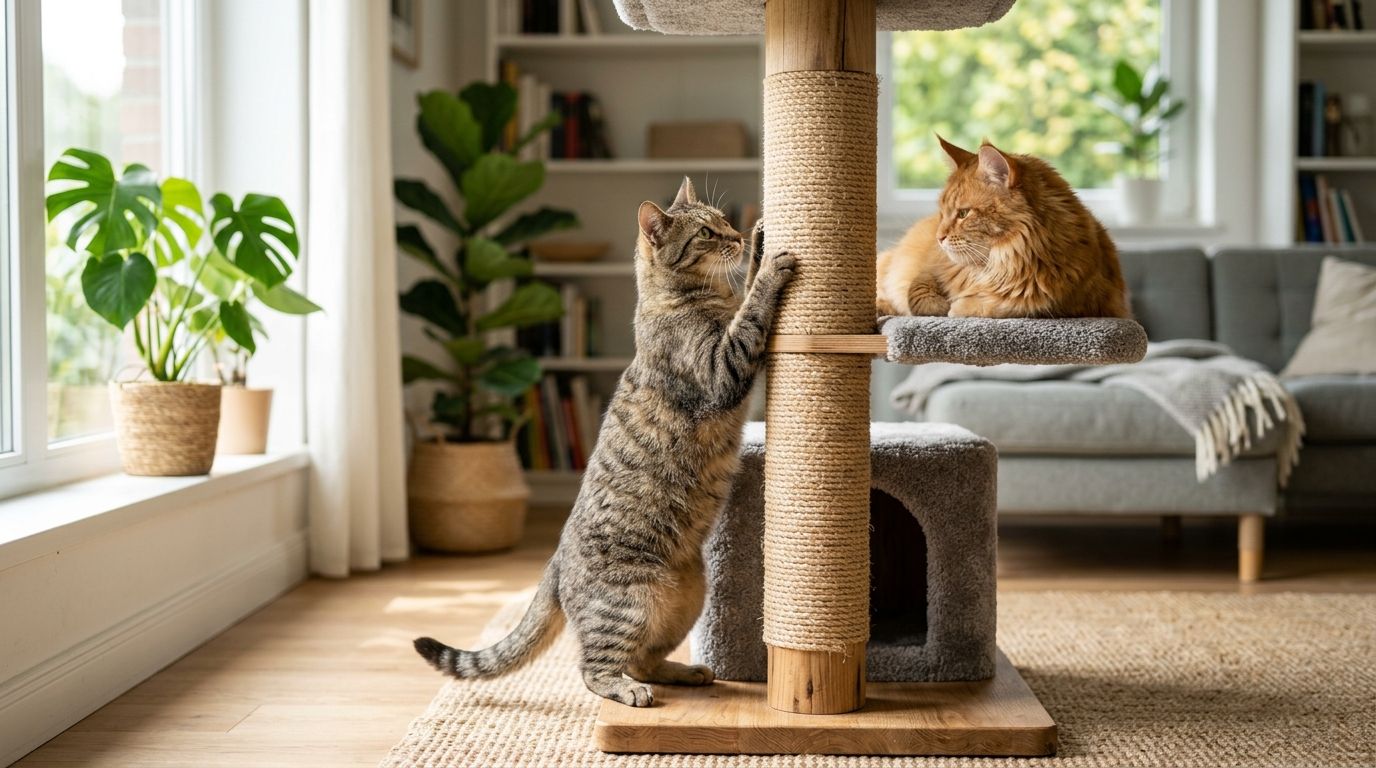
Indoor cats scratch to shed old claw sheaths, stretch their spine and mark territory with scent glands in their paws — the right scratching post gives them somewhere to do all three instead of your sofa arm. This guide ranks the five scratching post styles that suit Sydney apartments and houses in 2026, with a clear pick for every household type.
- A tall sisal-rope post is the best overall cat scratching post for indoor cats in 2026 — buy one first.
- Cardboard scratcher pads cost less and get chewed through faster; treat them as a top-up, not the only post.
- Multi-level cat trees solve scratching and vertical territory at once for two-cat and three-cat homes.
- Wall-mounted scratchers save floor space in small Northern Beaches apartments but need a stud or solid mount.
Why this matters
Scratching isn't destructive behaviour — it's grooming. Cats shed the outer sheath of their claws through repeated scratching, stretch the muscles along their spine, and mark territory through scent glands in their paws. Skip the post and that instinct redirects to your couch arm, a door frame, or the stair carpet.
Indoor cats scratch more than outdoor cats simply because they have fewer natural surfaces — bark, fence posts, tree trunks — to work with. At Two by Two Vet checkups across Balgowlah and the wider Northern Beaches, overgrown or split claws show up most often in indoor-only cats without a proper scratching post, and claw trims turn into a recurring appointment instead of a rare one.
A cat that scratches a familiar post daily also tends to handle stress better in general. If your cat gets anxious in the car or the waiting room, pairing a familiar scratching post at home with calming products for vet visits helps more than either step alone.
What makes the best scratching post for indoor cats
- Material — sisal rope holds up to daily clawing far longer than carpet or loose fabric.
- Height — a post needs to be at least 32 inches (80cm) tall so an adult cat can stretch to full length.
- Base stability — a wobbly post gets abandoned within a week; weighted or wide bases win out.
- Orientation options — some cats prefer vertical scratching, others go horizontal; the safest setup covers both.
- Placement flexibility — a post that sits near a window, doorway or favourite nap spot gets used more than one shoved in a spare room corner.
- Multi-cat capacity — households with more than one cat need enough surfaces that nobody has to queue for a turn.
Cat scratching posts at a glance (2026)
| Type | Best for | Standout feature | Key limitation |
|---|---|---|---|
| Sisal-rope vertical post | Indoor cats overall | Full-stretch height, durable rope | Takes up floor space |
| Cardboard scratcher pad | Budget top-up | Cheap to replace, cats love the texture | Wears through in weeks under heavy use |
| Multi-level cat tree | Multi-cat households | Combines scratching with climbing and perching | Bulky, needs a real room corner |
| Wall-mounted scratcher | Small apartments | Zero floor footprint | Needs a stud or solid wall fixing |
| Horizontal sisal mat | Kittens and senior cats | Low to the ground, easy access | No full vertical stretch |
1. Sisal-rope vertical post: best cat scratching post for indoor cats overall
A tall post wrapped in tightly wound sisal rope gives an indoor cat the full-body stretch and shredding resistance that cardboard or carpet can't match. Look for a base at least as wide as the post is tall — anything narrower tips over on the first hard pull, and most cats won't go back to a post that's fallen once.
Sisal-rope post pros:
- Handles years of daily scratching without shredding through
- Tall models let adult cats fully extend their spine
- Rope texture matches what cats seek out in bark and fence posts
Sisal-rope post cons:
- Takes up more floor space than a pad or wall mount
- Cheaper models use thin rope that loosens within months
- Needs re-wrapping or replacement eventually even on the good ones
Best for: any indoor cat as the primary scratching surface. Verdict: Buy — this is the one post every indoor cat household should own first.
2. Cardboard scratcher pad: best budget cat scratching option
A flat or angled cardboard scratcher gives cats a satisfying shred without the cost of a full sisal post. Corrugated cardboard rips apart in layers, which most cats find more rewarding than smooth carpet or fabric.
Cardboard scratcher pros:
- Lowest-cost entry point into scratcher training
- Lightweight enough to move between rooms
- Replaceable in minutes once worn through
Cardboard scratcher cons:
- Shreds through fast under a heavy scratcher
- Mostly flat or low-angle, so it doesn't cover full-stretch scratching
- Cardboard dust and bits scatter across the floor
Best for: topping up a household that already has a tall post, or trialling scratcher training with a new kitten. Verdict: Buy — as a supplement, not a replacement for a proper post.
3. Multi-level cat tree: best cat scratching post for multi-cat households
A cat tree with sisal-wrapped posts built into two or three levels solves scratching and vertical territory at the same time. In a two-cat or three-cat home, that vertical space matters — cats that share a floor plan but not a favourite perch fight less.
Cat tree pros:
- Multiple scratching surfaces across one footprint
- Perches double as safe distance between cats that don't get along
- Sisal posts are usually thicker and better anchored than standalone posts
Cat tree cons:
- Larger footprint needs a genuine corner, not a hallway
- Higher upfront cost than a single post
- Some cheaper trees use carpet instead of sisal on the posts
Best for: households with two or more cats, or one cat that needs more vertical territory. Verdict: Buy — the extra cost pays off fast in a multi-cat home.
4. Wall-mounted corner scratcher: best cat scratching post for small apartments
A wall-mounted post or corner scratcher fixes to a stud and sits flush against the wall, freeing the floor for everything else. It suits a Manly or Balgowlah unit where every square metre of floor space counts.
Wall-mounted scratcher pros:
- Zero floor footprint
- Fixes at a height you choose, matching your cat's stretch
- Works well angled into a corner cats already favour
Wall-mounted scratcher cons:
- Needs a stud or solid fixing point — plasterboard alone won't hold it
- Fixed height won't suit a growing kitten long-term
- Not stable enough for cats that scratch aggressively at an angle
Best for: apartments and units with limited floor space. Verdict: Hold — solid pick once you've confirmed a proper wall fixing; skip it if you're renting and can't drill in.
5. Horizontal sisal mat: best cat scratching post for kittens and senior cats
A low, flat sisal mat sits on the floor and lets a cat scratch without reaching up. Kittens still building coordination and senior cats with joint stiffness both do better with a scratcher they don't have to stretch or climb to use.
Horizontal mat pros:
- No climbing or stretching required
- Easy to place near a bed or favourite sleeping spot
- Low cost and simple to replace
Horizontal mat cons:
- Doesn't give a full vertical stretch adult cats often want
- Can slide on hard floors without a rubber backing
- Won't satisfy a cat that strongly prefers vertical scratching
Best for: kittens, senior cats, or cats recovering from joint issues. Verdict: Buy — as a second surface alongside a vertical post, not instead of one.
How we ranked these
The ranking comes down to four things: material durability under daily clawing, whether the post lets a cat fully stretch, base or mount stability, and how well each style fits a specific household — solo cat, multi-cat, small apartment, kitten or senior. Sisal rope wins on durability and stretch. Cardboard wins on cost. Cat trees win on multi-cat capacity. Wall mounts win on floor space. Horizontal mats win on accessibility.
Which scratching post should you choose?
For most indoor cats in 2026, a tall sisal-rope post is the default buy — it covers stretch height and durability better than any other style on this list. Add a cardboard pad near the litter tray or a sleeping spot as a cheap top-up. Got two or more cats? Upgrade to a multi-level cat tree instead of a single post. Renting a small Northern Beaches unit? A wall-mounted scratcher solves the space problem, provided you can fix it into a stud. Kittens and older cats do best with a horizontal mat alongside whichever vertical option you pick. If your cat's scratching habits change suddenly, mention it at your next Two by Two Vet visit — sudden avoidance of a favourite scratching post can flag joint pain worth checking.
Book a wellness check
Get your cat's claws checked at Two by Two Vet in Balgowlah.
FAQ
What's the best cat scratching post for indoor cats?
A tall sisal-rope post, at least 32 inches high with a wide base, is the best all-round option for indoor cats in 2026. It handles daily clawing without shredding and lets an adult cat fully stretch its spine.
Is a cat tree better than a single scratching post?
A multi-level cat tree works better than a single post in households with two or more cats because it adds vertical territory as well as scratching surfaces. For a single cat, a standalone sisal post is usually enough.
How many scratching posts does a cat need?
The standard feline behaviourist guideline is one scratching post per cat, plus one extra placed somewhere else in the home. A two-cat household should have at least three scratching surfaces.
Do cardboard scratchers work as well as sisal posts?
Cardboard scratchers work well as a cheap, replaceable top-up but wear out faster than sisal rope under daily use. Most households do best pairing a cardboard pad with one tall sisal post.
Where should I put a cat scratching post?
Place the first post near where your cat already sleeps, eats or enters the home, since cats scratch to mark territory in high-traffic spots. A post hidden in a spare room often gets ignored.
Can a scratching post stop a cat from scratching furniture?
A tall, sturdy post positioned near the furniture a cat currently targets redirects most scratching within a few weeks. Cats that keep scratching furniture usually need a taller or sturdier post, not a punishment.
Do kittens need a different scratching post than adult cats?
Kittens do better with a low horizontal mat while they build coordination, then transition to a tall vertical post as they grow. A wobbly full-height post can put a kitten off scratching altogether.
How do I know if my cat's claws need a vet check instead of just a post?
If claws look overgrown, curl into the paw pad, or your cat limps after scratching, book a claw and paw check with Two by Two Vet rather than relying on a scratching post alone. A scratching post supports healthy claws, but it doesn't replace a vet check when something looks wrong.
One last thing
Don't wash a scratching post with soap or disinfectant once your cat starts using it — the scent left behind from the glands in their paws is exactly what draws them back to the same spot. A quick shake or vacuum to clear cardboard dust is enough; skip the deep clean.