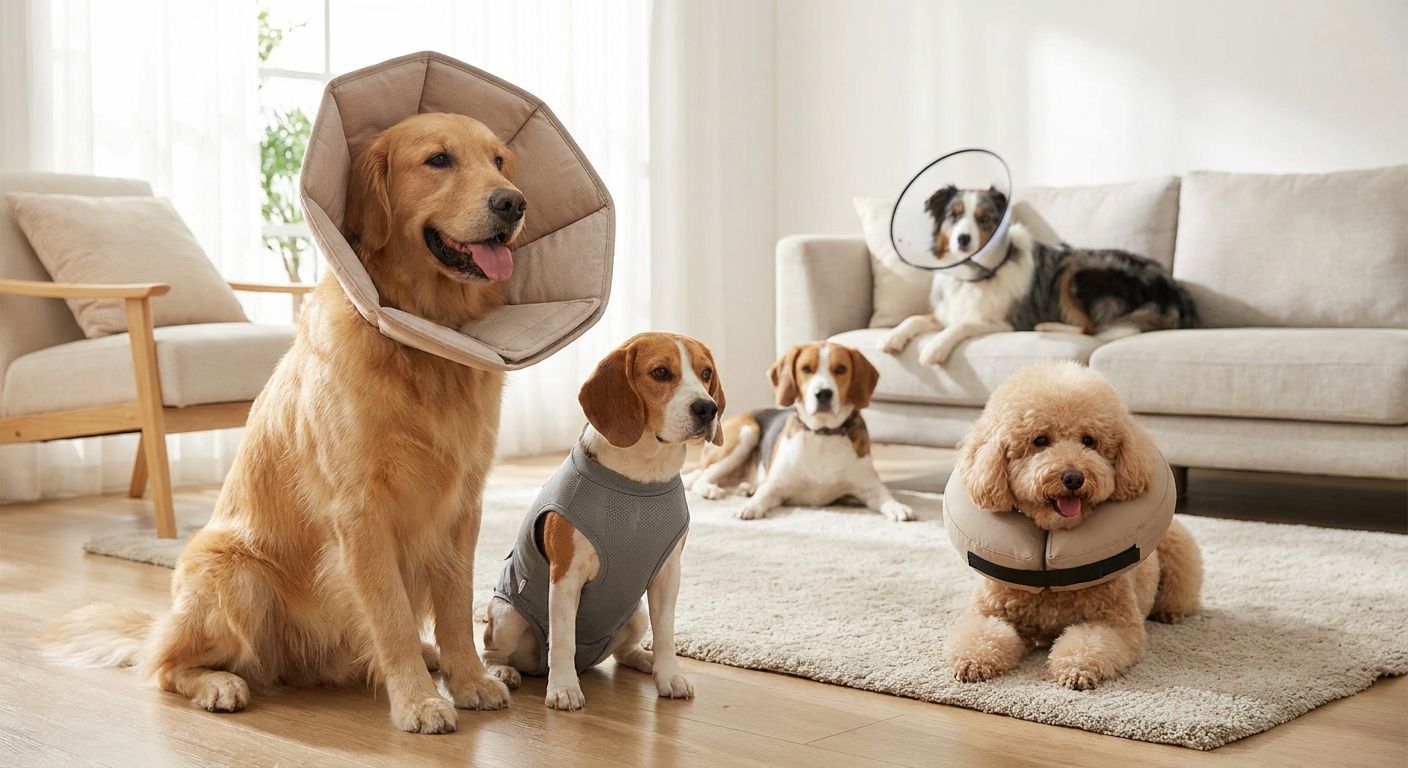
A dog recovering from desexing surgery needs a barrier that stops licking and chewing for 10 to 14 days while the incision closes, and the right choice depends on your dog's temperament, coat, and how determined they are to get at that wound.
- The best recovery cone for dog after desexing for most owners in 2026 is a recovery suit, worn alongside a rigid E-collar for the first few days.
- A classic rigid E-collar remains the most reliable barrier for heavy lickers and chewers.
- Inflatable donut collars suit cats and toy breed dogs but don't fully block access to a flank incision.
- Soft fabric cones are the easiest option for anxious dogs but tear if a determined chewer works at the edge.
- Neck pillow collars work well for senior dogs and flat-faced breeds that struggle with a rigid cone's weight.
Why this matters
A desexing incision that gets licked open turns a routine day-surgery into a return trip for stitches, sedation, and sometimes a second anaesthetic. The team at Two by Two Vet in Balgowlah sees this every few weeks: a dog left uncovered overnight, and a wound that needed re-closing the next morning.
The fix isn't complicated, but the wrong cone or suit fails in predictable ways. Rigid cones get knocked off doorframes and abandoned. Suits ride up and expose the incision when a dog rolls onto its back. Inflatable collars let a flexible-spined dog curl around and reach a flank cut. Picking the right option for your dog's build and personality in 2026 matters more than picking the most expensive one.
What makes the best recovery cone or suit
- Barrier effectiveness — does it physically stop the tongue reaching the incision, even when the dog contorts
- Comfort and mobility — can the dog eat, drink, navigate stairs, and sleep without bruising itself on furniture
- Ease of fitting — can you get it on and adjust it at home without a second person holding the dog still
- Suitability for build — works with the dog's neck length, coat, and incision location (midline vs scrotal vs flank)
- Durability across 10-14 days — survives the full healing window without needing daily repairs
- Ease of replacement — simple to size up if your dog is still growing or the fit loosens
Recovery cones and suits at a glance
| Option | Best for | Standout feature | Key limitation |
|---|---|---|---|
| Recovery suit (onesie) | Overall post-desexing wear | Full mobility, no head barrier to bump into walls | Doesn't fully stop a flexible dog reaching a flank cut |
| Classic rigid E-collar | Heavy lickers and chewers | Physically blocks all access to the wound | Bulky; dogs bump into doorframes and furniture |
| Inflatable donut collar | Cats and toy breed dogs | Lightweight and comfortable for sleeping | Flexible dogs can still curl around and reach the incision |
| Soft fabric cone | Budget-friendly comfort | Folds flat, less startling than a rigid cone | Tears under sustained chewing |
| Neck pillow collar | Senior dogs and brachycephalic breeds | Very light, doesn't strain the neck | Weakest barrier of the five |
1. Recovery Suit (Onesie): Best Overall for Standard Desexing Incisions
A recovery suit covers the torso and incision with a soft, stretch fabric body, leaving the head and legs free. For a straightforward midline spay or neuter incision, it keeps the wound covered without the dog banging its head on every door frame in the house.
Recovery suit pros:
- Full mobility — eating, drinking, and sleeping are unaffected
- No head-mounted barrier to knock furniture or spook the dog
- Generally better tolerated by anxious dogs than a rigid cone
Recovery suit pricing: varies by size and fabric — check current stock for your dog's measurements before ordering.
Recovery suit cons:
- A flexible dog can still curl around and lick through thin fabric
- Rides up if the fit is loose, exposing the incision overnight
- Needs daily checks that the wound is still fully covered
Best for: dogs with a standard, low-risk midline incision and a calm temperament. Verdict: Buy — but pair it with a rigid E-collar overnight for the first three to four days if your dog is a known licker.
2. Classic Rigid E-Collar (Elizabethan Collar): Best for Heavy Lickers and Chewers
The rigid plastic cone is the oldest option and still the most reliable barrier available. It physically prevents the tongue reaching any part of the body behind the collar's edge, which is why vets default to it for dogs that won't stop worrying at a wound.
Rigid E-collar pros:
- Blocks access to the incision completely, regardless of how the dog contorts
- Works for any incision location — midline, scrotal, or flank
- Cheap to replace if damaged
Rigid E-collar cons:
- Bulky and noisy against walls, furniture, and food bowls
- Some dogs refuse to eat or drink normally in the first day or two
- Restricts peripheral vision, which unsettles nervous dogs
Best for: determined lickers, chewers, and any dog whose incision has already been disturbed once. Verdict: Buy — the default recommendation when in doubt, and the option Two by Two Vet sends home after most desexing procedures.
3. Inflatable Donut Collar: Best for Cats and Toy Breed Dogs
An inflatable collar sits around the neck like a travel pillow, blocking forward reach without the rigid cone's bulk. It works well for smaller animals with shorter necks and less flexibility.
Inflatable collar pros:
- Comfortable enough for most cats and small dogs to sleep normally
- Doesn't restrict peripheral vision the way a rigid cone does
- Easy to wipe clean
Inflatable collar cons:
- A flexible-spined dog or cat can still curl around it to reach a flank or hind incision
- Loses effectiveness if under-inflated
- Not suitable for larger, more mobile breeds
Best for: cats and toy breed dogs with a midline incision, where the neck restricts reach. Verdict: Hold — fine for smaller patients, but skip it for medium and large dogs recovering from desexing.
4. Soft Fabric Cone: Best Budget-Friendly Comfort Option
A soft fabric cone folds flat and uses a wire or plastic-reinforced rim instead of rigid plastic. It's less startling for nervous dogs and doesn't clatter against doorways the way a hard cone does.
Soft cone pros:
- Lighter and quieter than a rigid E-collar
- Folds down for sleeping or car travel
- Easier for anxious dogs to accept
Soft cone cons:
- Tears under sustained chewing from a determined dog
- Less rigid, so a flexible neck can partially bypass it
- Needs more frequent adjustment as fabric loosens
Best for: mild-mannered dogs who tolerate a cone but panic at a rigid one. Verdict: Buy — a solid middle option, provided your dog isn't a known chewer.
5. Neck Pillow Collar: Best for Senior Dogs and Brachycephalic Breeds
A neck pillow collar is essentially a padded ring worn like a travel pillow, offering minimal restriction. It suits older dogs with arthritis or flat-faced breeds like French Bulldogs and Pugs, who struggle with the weight and drag of a rigid cone.
Neck pillow pros:
- Very light, doesn't strain an arthritic neck
- Comfortable for breeds with breathing difficulty made worse by cone weight
- Simple to fit without help
Neck pillow cons:
- The weakest barrier of the five options here
- Not appropriate for a dog with any history of licking or chewing
- Offers almost no protection for a flank incision
Best for: senior or brachycephalic dogs with a low-risk incision and no licking history. Verdict: Wait — only suitable if your vet has confirmed your dog is a low-risk case for self-trauma.
How we ranked these
Each option was assessed against barrier effectiveness first, since a failed barrier means a return visit and a second sedation. Comfort, mobility, and ease of fitting followed, because a cone a dog fights against for two weeks causes its own stress. Durability across the 10 to 14 day healing window and ease of replacement rounded out the criteria — a suit that needs replacing every three days isn't practical for most households in 2026.
Book your dog's desexing consult
Talk through recovery options before the day of surgery.
Which recovery cone or suit should you choose?
If your dog is calm and this is a standard midline incision, start with a recovery suit and keep a rigid E-collar on hand for the first few nights. If your dog has ever licked at a wound, scratched at stitches, or is simply a determined chewer, go straight to the rigid E-collar — it's the only option on this list that guarantees the incision stays untouched. Cats and toy breeds do well with an inflatable collar; senior and flat-faced dogs with low-risk incisions can often get by with a neck pillow collar, but check with your vet first.
Whatever you choose, keep your dog's activity restricted and the incision dry for the full 10 to 14 days, and recheck the wound daily for redness, swelling, or discharge.
FAQ
What's the best recovery cone for a dog after desexing?
A rigid E-collar is the most reliable barrier for most dogs after desexing, because it physically blocks all access to the incision. A recovery suit works well too, provided the dog doesn't have a history of licking or chewing.
Is a recovery suit better than a cone after desexing?
A recovery suit is more comfortable and easier to live with day to day, but it doesn't guarantee the same barrier effectiveness as a rigid cone. Calm dogs with standard midline incisions usually do fine in a suit; known lickers need a rigid E-collar.
How long does my dog need to wear a cone after being desexed?
Most dogs need the cone or suit for the full 10 to 14 days it takes the incision to heal. Your vet will confirm the exact timeline at the post-op check.
Can I use a soft cone instead of a hard cone after surgery?
A soft fabric cone works for mild-mannered dogs that tolerate a cone but tears under sustained chewing. Determined lickers and chewers need the rigid version.
Do inflatable collars work for major surgery like desexing?
Inflatable donut collars work well for cats and toy breed dogs but a flexible-spined animal can still curl around one to reach a flank incision. They're not recommended for medium or large dogs after desexing.
What if my dog manages to get the cone off?
Check the incision immediately for redness, swelling, or licking damage, refit the collar or suit, and call your vet if the wound looks disturbed. A cone that's easy to remove usually needs resizing.
Can my dog sleep in a recovery cone?
Yes, though a soft cone or recovery suit is more comfortable overnight than a rigid E-collar. Some owners switch to the rigid collar only when unsupervised and use a softer option while the dog is resting nearby.
When can I stop using the recovery cone or suit?
Stop only once your vet confirms the incision is fully healed, typically at the 10 to 14 day post-op check. Removing it early is the most common reason for a reopened wound.
One last thing
A recovery suit alone often fails on flexible dogs because they can still bend around and lick through the fabric at the flank — if your dog is a known contortionist, keep the rigid E-collar on for unsupervised hours even if the suit is doing most of the daytime work. Combining both, rather than picking one, is what actually gets most dogs through the full 10 to 14 days without a reopened incision in 2026.