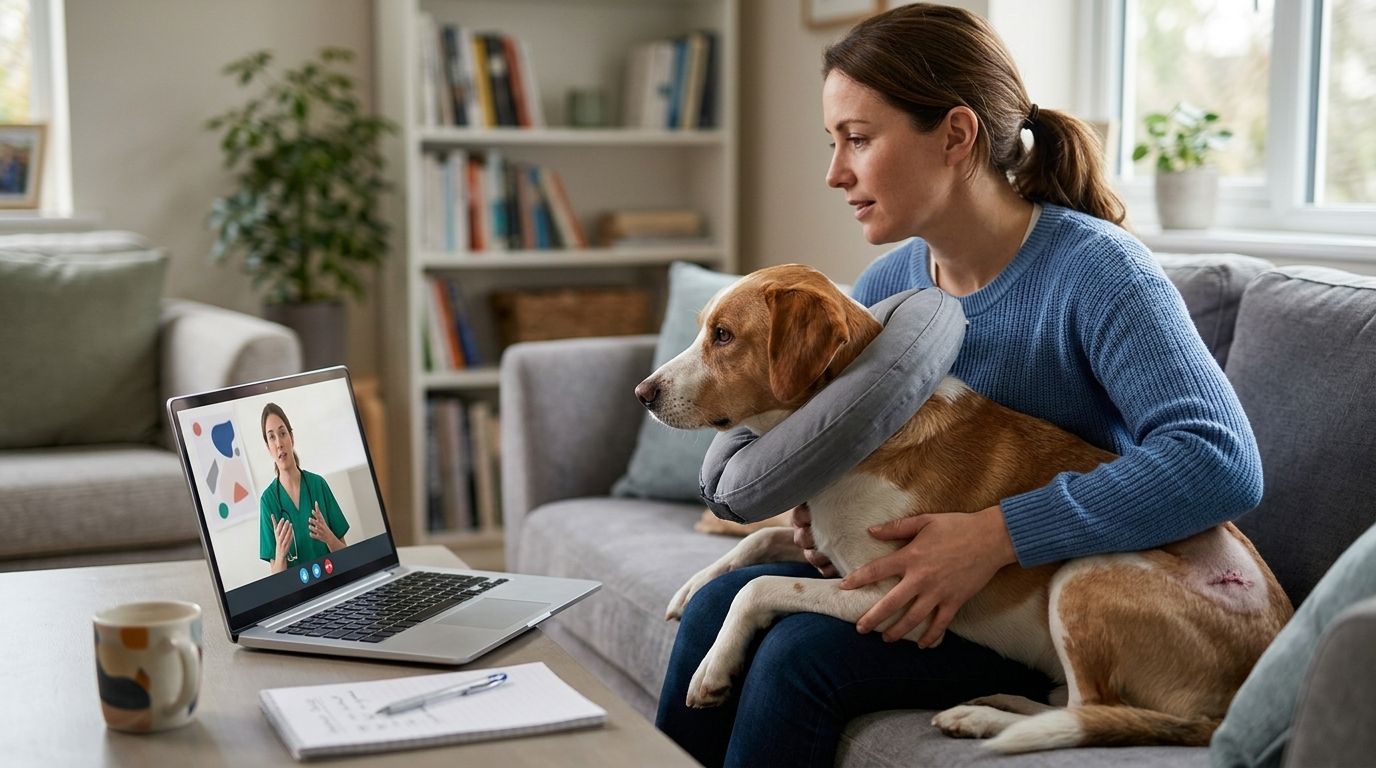
Telehealth follow-up after dog desexing is a scheduled video call, usually 3 to 5 days after surgery, where the vet checks the incision site on camera, asks about appetite, energy and toileting, and decides whether your dog needs to come back in person. Instead of driving to Balgowlah for a five-minute wound check, you hold the phone up to the incision, answer a handful of questions, and get cleared to move to the next recovery stage without leaving the house.
- Telehealth follow-up after dog desexing happens 3 to 5 days post-op via a scheduled video call.
- Two by Two Vet checks the incision, appetite and energy level on camera before deciding on next steps.
- Swelling, discharge or a dog chewing through the cone means the call gets upgraded to an in-person recheck.
- Good lighting and a calm, leashed dog matter more than camera quality for a useful check.
Why this matters
Most desexing complications show up in the first week: incision redness, swelling, licking damage or a dog that stops eating. A telehealth check catches these early without forcing every dog owner on the Northern Beaches back into the car two or three days after anaesthesia. In 2026, video consults are a standard part of post-surgery care at clinics like Two by Two Vet, not a special request.
The trade-off is real: a vet cannot palpate the incision or listen to heart and lung sounds through a screen. Telehealth works as a triage step, not a replacement for hands-on assessment when something looks wrong. Knowing that distinction before the call saves you a second appointment.
Before you start
- A device with a working front or rear camera — phone, tablet or laptop, tested beforehand so the call doesn't stall on a permissions prompt.
- Discharge paperwork from surgery day — the vet will reference medication instructions, suture type and the planned cone-removal date.
- A leash and a second pair of hands if possible — a wriggling dog plus a one-handed phone grip is the single biggest reason telehealth checks run long or miss the incision entirely.
The non-obvious gotcha: video quality matters far less than lighting. A dim hallway or a backlit window makes it impossible for the vet to judge whether the skin around the incision is pink and healing or red and inflamed. Do the call near a window in daylight or under a bright overhead light, not under a lamp that throws shadows across the belly.
If the follow-up wasn't already booked at discharge, you can book with Two by Two Vet directly.
Book the follow-up window
- Confirm the timing with the clinic at discharge. Most desexing recoveries get checked between day 3 and day 5 post-op, ahead of the day 10 to 14 suture or wound-closure check.
- Note whether your dog had a spey (female) or castration (male) procedure. The incision site and healing pattern differ, and the vet will ask upfront if it isn't already on file.
- Confirm the format — live video call, or phone call plus photos. Clinics vary on what they default to for routine desexing checks, and it changes how you prepare.
Expected result: a locked-in time slot, a known call format, and the discharge paperwork within arm's reach at that time.
Set up the call and the dog
- Open the video link or app 2 minutes early to clear software updates and camera permission prompts.
- Put your dog on a non-slip surface. Tile or a towel over hard floor beats carpet, where a nervous dog digs in and turns away from the camera.
- Make the incision area reachable. For most desexing sites that means the lower abdomen, so one training treat to keep your dog standing still for 20 to 30 seconds is the difference between a clear look and a blurry one.
- Keep the recovery cone or suit nearby, ready to loosen briefly if the vet asks to see the site unobstructed.
Expected result: the vet gets a clear, well-lit view of the incision and can ask questions without repeating themselves because the dog keeps wandering off-camera.
What the vet checks on camera
- Incision appearance — a thin margin of pink is normal in the first week. Spreading redness, swelling or gaping skin edges is not.
- Discharge — a small amount of clear fluid in the first 24 to 48 hours is common. Anything yellow, green or foul-smelling gets escalated.
- Appetite and behaviour — a dog eating normally and moving around the house by day 3 is the strongest single sign of a routine recovery.
- Cone compliance — the vet will ask whether your dog has managed to lick or bite the site despite the cone, because that is the leading cause of a reopened incision.
If everything checks out, the vet confirms when normal activity can resume and sets the date for the cone-removal or suture check.
Variant: the pre-cone-removal check
The same call format covers the second checkpoint, usually day 10 to 14, when the question shifts from "is this healing" to "can the cone come off". The preparation is identical, but the vet is looking for a fully closed incision line rather than early inflammation.
Do not remove the cone on your own judgement at day 8 because the wound looks fine. Surface closure runs ahead of deeper tissue healing, and a dog with 48 hours of unsupervised access to a nearly-healed incision is the classic emergency recheck.
When you need an in-person recheck instead
A telehealth call is the wrong tool for some situations, and a vet doing the job properly will say so rather than guess through a screen. Book an in-person recheck when:
- The incision shows spreading redness, swelling, or any gap in the skin edges.
- There is discharge with an odour, or bleeding beyond light spotting.
- Your dog has licked, chewed or scratched the site despite the cone.
- Your dog is lethargic, refusing food for more than 24 hours, or vomiting.
None of these need a long debate on camera. A vet who spots any of them moves you to a same-day slot rather than talking you through home care for something that needs hands.
Book your desexing follow-up
Schedule a telehealth check or an in-person recheck with Two by Two Vet in Balgowlah.
Troubleshooting
The vet can't get a clear view of the incision. Move to better light and use a treat to hold your dog's attention for a few more seconds, rather than repositioning the camera over and over.
Your dog won't stay still. Run the call after a short lead walk when energy is lower, and have a second person hold the leash while you handle the phone.
You're not sure whether what you're seeing is normal. Take a still photo in good light before the call and have it open. A sharp static image beats shaky video for judging redness.
The call keeps dropping. Switch to wifi instead of mobile data, or fall back to a phone call plus timestamped photos if video won't hold.
You missed the window. Call the clinic instead of skipping the check. A late telehealth follow-up is still worth doing, and a desexing incision should not go unchecked past day 5 or 6.
Customise your recovery plan
What happens after the telehealth check depends on size and temperament. Small breeds tend to bounce back faster but chew at incisions more; large breeds carry more tissue disruption from the same procedure and need longer activity restriction. The guides for dog desexing for small breed dogs and large breed desexing recovery break the timelines down by size.
Verdict: a telehealth follow-up after dog desexing is the right first step for a routine recovery, and the wrong tool the moment redness, discharge or lethargy shows up on camera.
FAQ
How soon after dog desexing is the telehealth follow-up?
Most telehealth follow-ups after dog desexing happen 3 to 5 days post-surgery. That timing lets the vet check the incision and behaviour well before the day 10 to 14 wound-closure check.
Can a vet fully assess a desexing incision over video?
A vet can visually check for redness, swelling and discharge over video, but cannot palpate the site or listen to heart and lung sounds remotely. Anything abnormal on camera gets escalated to an in-person recheck.
What if my dog won't sit still for the telehealth call?
Run the call after a short walk when energy is lower, and use a treat to hold attention for the 20 to 30 seconds the vet needs. A second person on the leash makes it far easier.
Is the telehealth follow-up included with desexing surgery?
Follow-up arrangements vary between clinics, so ask at discharge what the desexing package includes. Confirm the format and timing at the same time so nothing is assumed.
What signs mean I need an in-person recheck instead of a video call?
Spreading redness, swelling, discharge with an odour, bleeding, lethargy, or refusing food for more than 24 hours all need hands-on assessment. Book an in-person recheck rather than a video call for any of these.
Do male and female dogs have different follow-up needs after desexing?
Yes. A spey and a castration involve different incision sites and healing patterns, so the vet confirms which procedure was performed before assessing the site on camera.
Can I send photos instead of doing a live video call?
Some clinics accept timestamped photos alongside a phone call, which helps if your dog won't cooperate on camera. Ask which format the clinic prefers when you book.
When does the recovery cone come off after desexing?
The cone stays on until the incision has fully closed, usually confirmed at the day 10 to 14 check. Taking it off early is the most common cause of a reopened incision.
One last thing
The most common reason a telehealth follow-up gets upgraded to an in-person recheck is not infection — it is a dog that found a way around the cone. A cone or suit that actually stops licking prevents more reopened incisions than any other piece of post-op equipment, and the fit is worth checking on day 1 rather than day 6. Start with the post-desexing recovery cones and suits comparison before surgery day, not after.