Nina Ottosson's Dog Brick tops the list for 2026, the Kong Wobbler wins for treat-driven chow hounds, and Outward Hound's Hide-A-Squirrel is the budget pick for owners who want enrichment without the price tag of a levelled system.
- Nina Ottosson Dog Brick is the best overall pick among interactive puzzle toys for dogs in 2026 for first-time owners.
- Kong Wobbler suits high-energy, food-motivated dogs that need a workout at mealtime.
- West Paw Toppl works well for anxious dogs and dogs on vet-prescribed crate rest.
- Outward Hound Hide-A-Squirrel is the budget option for soft-toy chewers and puppies.
- Nina Ottosson Dog Tornado is built for advanced dogs that solve easier puzzles in under a minute.
Why this matters
A bored dog isn't just a nuisance - it's a dog whose brain isn't getting used, and under-stimulation shows up as destructive chewing, excessive barking, weight gain, and in some cases anxiety that owners mistake for a behavioural problem rather than a management gap. Interactive puzzle toys give dogs a job to do, which slows down fast eaters, extends mealtime from ninety seconds to twenty minutes, and gives anxious dogs something to focus on other than the front door.
If your dog already shows signs of stress - pacing, panting at rest, destructive chewing when left alone - a puzzle toy helps, but it's a management tool, not a cure. Check the calming aids for anxious dogs guide if enrichment alone isn't cutting the anxiety, and if you're unsure whether your dog's behaviour needs a proper workup, book a visit through Two by Two Vet rather than guessing.
What makes the best interactive puzzle toys for dogs
- Difficulty scaling - a good toy has an easy setting for beginners and a harder configuration for dogs that master it
- Durability - the toy survives paws, teeth, and being flung across a tile floor without cracking
- Cleanability - dishwasher-safe or wipeable, because food residue in crevices turns into a mess fast
- Size-appropriate for the dog - a Great Dane and a Cavoodle need different scales of the same puzzle
- Genuine mental challenge - not just a treat dispenser that empties in ten seconds
- Safe materials - no small parts that break off and get swallowed
Interactive puzzle toys for dogs at a glance
| Toy | Best for | Standout feature | Key limitation |
|---|---|---|---|
| Nina Ottosson Dog Brick | First-time puzzle owners | Sliding compartments with adjustable difficulty | Plastic pieces can be flipped out by strong-jawed dogs |
| Kong Wobbler | Food-driven, high-energy dogs | Weighted base wobbles unpredictably to slow eating | Loud on hard floors, not ideal for noise-sensitive households |
| West Paw Toppl | Anxious dogs and crate rest | Stuffable, freezable, made for long-lasting licking | Needs filling with food or paste to work, not standalone |
| Trixie Flip Board | Senior dogs with stiff joints | Low physical effort, flat surface, easy paw access | Limited challenge for younger or more advanced dogs |
| Outward Hound Hide-A-Squirrel | Budget-conscious owners, puppies | Soft plush squeakers hidden in a fabric tree trunk | Not suited to dogs that destroy soft toys in minutes |
| Nina Ottosson Dog Tornado | Advanced, high-IQ working breeds | Multi-layer rotating disc with hidden compartments | Too complex for a dog new to puzzle feeding |
1. Nina Ottosson Dog Brick: best interactive puzzle toy for first-time owners
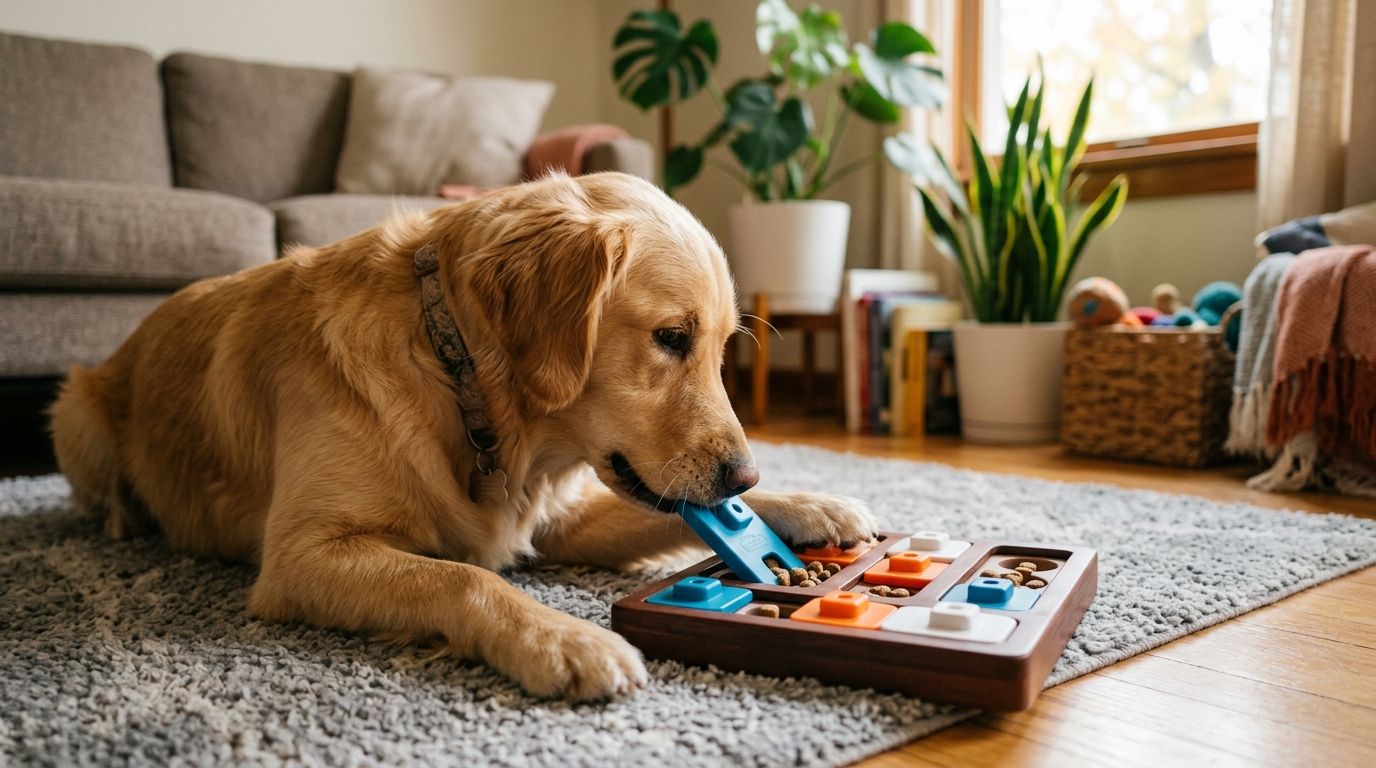
The Dog Brick uses sliding plastic bricks that a dog has to nose or paw aside to reach kibble or treats hidden underneath. It's the entry point most trainers recommend because the mechanism is visible - dogs can watch the treats disappear and work out cause and effect quickly, usually within the first session.
Dog Brick pros:
- Adjustable difficulty by removing or adding brick pieces
- Dishwasher-safe on the top rack
- Flat, low-profile design won't tip and spill everywhere
Dog Brick cons:
- Determined chewers can pop bricks out and chew them separately
- Not challenging enough once a dog has mastered it after a few weeks
Best for: dogs and owners new to puzzle feeding who want a toy that teaches the concept without frustrating the dog on day one.
Verdict: Buy. It's the safest starting point in 2026 and cheap enough to replace if a dog outgrows it.
2. Kong Wobbler: best interactive puzzle toy for food-driven dogs
The Wobbler is a weighted, egg-shaped dispenser that rocks and rolls unpredictably when nudged, releasing kibble through an adjustable opening. It's built for dogs that inhale their food in under a minute and need mealtime slowed down physically rather than mentally.
Kong Wobbler pros:
- Adjustable dispensing hole controls how fast treats fall out
- Tough enough for dogs that headbutt or body-slam their toys
- Doubles as a full meal dispenser, not just a treat toy
Kong Wobbler cons:
- Rolling and clattering on tile or timber floors is loud
- Less mentally demanding than lever or sliding-panel puzzles
Best for: fast eaters and food-obsessed dogs that need a physical challenge more than a cognitive one.
Verdict: Buy for dogs with carpeted areas to roll it on; Hold if your floors are all hard surface and noise is a concern.
3. Trixie Flip Board: best interactive puzzle toy for senior dogs with joint stiffness
The Flip Board sits flat on the floor with small lids a dog flips open with a nose or paw, avoiding the digging, pawing, and jumping that harder puzzles demand. For a senior dog with arthritis or reduced mobility, that flat, low-effort design matters more than raw difficulty.
Flip Board pros:
- No lifting, digging, or jumping required to access treats
- Non-slip base stays put on timber and tile floors
- Gentle enough for dogs recovering from joint surgery or flare-ups
Flip Board cons:
- Too easy for a young, food-motivated dog after a week or two
- Smaller treat capacity than box-style puzzles
Best for: senior dogs, dogs with arthritis, or any dog recovering from a joint procedure that needs enrichment without physical strain. Pair it with a look at joint supplements for older dogs if stiffness is a daily issue rather than an occasional one.
Verdict: Buy for senior or post-op dogs; Skip for a young, healthy dog that needs more of a workout.
4. West Paw Toppl: best interactive puzzle toy for anxious dogs and crate rest
The Toppl is a stuffable rubber cone, not a mechanical puzzle - you fill it with wet food, kibble paste, or a frozen mix and the dog works to lick it clean over ten to twenty minutes. That slow, repetitive licking action has a calming effect that mechanical puzzles don't replicate.
Toppl pros:
- Freezable, which extends the working time significantly
- Natural rubber holds up to enthusiastic chewing
- Two stack together to make the challenge harder as the dog improves
Toppl cons:
- Requires prep time filling and freezing before use
- Not a stimulation toy on its own - it needs food inside to function
Best for: anxious dogs during alone time, and dogs on enforced rest after surgery who need calm, low-movement enrichment rather than an active puzzle. It works well alongside a supportive setup - see dog beds for post-surgery recovery if your dog is in a recovery period right now.
Verdict: Buy. It's one of the few toys that doubles as an anxiety tool and a recovery aid.
5. Outward Hound Hide-A-Squirrel: best interactive puzzle toy on a budget
This is the plush version of puzzle feeding - a fabric tree trunk with squeaky squirrel toys tucked into holes that a dog pulls out one at a time. It's not a food puzzle, but it engages the same hunting and foraging instinct that drives dogs to work at other puzzle types.
Hide-A-Squirrel pros:
- Machine washable, unlike most hard-shell puzzles
- Engages scent and search behaviour, not just treat-chasing
- Good size range for small to medium breeds and puppies
Hide-A-Squirrel cons:
- Soft fabric doesn't survive dogs that shred plush toys
- Squeakers can be a choking risk if the fabric tears open
Best for: puppies, small breeds, and owners testing whether their dog even enjoys puzzle-style play before spending more on a hard-shell option.
Verdict: Buy for gentle chewers and puppies; Skip entirely for a known plush-destroyer.
6. Nina Ottosson Dog Tornado: best interactive puzzle toy for advanced dogs
The Dog Tornado is a multi-layer rotating disc puzzle - a dog has to spin the top layer to line up openings, then dig through a second hidden layer underneath. It's the toy to graduate to once easier puzzles stop holding a dog's attention.
Dog Tornado pros:
- Two-layer design genuinely challenges dogs that have solved simpler puzzles
- Sturdy plastic construction handles repeated spinning without cracking
- Non-slip feet keep it stable during aggressive play
Dog Tornado cons:
- Frustrating for a dog with no puzzle-toy experience
- Larger footprint takes up more floor space than flat puzzles
Best for: working breeds and high-drive dogs (Border Collies, Kelpies, working line Labradors) that have already mastered a Level 1 or Level 2 puzzle.
Verdict: Buy once a dog has proven it can handle an easier puzzle first; Wait if this would be a dog's first-ever puzzle toy.
Unsure if it's enrichment or anxiety?
Book a check-up and get a proper read on your dog's behaviour.
How this list was ranked
Each toy was measured against the six criteria above - difficulty scaling, durability, cleanability, size fit, genuine mental challenge, and material safety - then slotted into the use case it serves best rather than stacked against every other toy on raw difficulty alone. That's why a flat, easy puzzle like the Trixie Flip Board sits alongside a two-layer Nina Ottosson Dog Tornado: they're not competing for the same dog.
“Twenty minutes with a puzzle feeder does more for a bored or anxious dog than twenty minutes of pacing by the front door.”
Which interactive puzzle toy should you choose in 2026?
If you're starting from zero, buy the Nina Ottosson Dog Brick - it teaches the concept without overwhelming the dog. If your dog inhales food in seconds, the Kong Wobbler slows things down physically. If anxiety or post-op recovery is the issue, the West Paw Toppl is the better fit than any mechanical puzzle. Only move to the Dog Tornado once a dog has proven it can solve something easier first - handing an advanced puzzle to a first-timer just leads to a frustrated dog that gives up.
FAQ
What are the best interactive puzzle toys for dogs in 2026?
The Nina Ottosson Dog Brick is the best overall pick for 2026, with the Kong Wobbler suited to fast eaters and the West Paw Toppl best for anxious or recovering dogs. The right choice depends on your dog's experience level and energy.
Are puzzle toys good for anxious dogs?
Yes - slow, repetitive puzzle activities like licking a stuffed Toppl can calm an anxious dog during alone time. For ongoing separation anxiety, pair enrichment with a look at proper calming strategies rather than relying on toys alone.
How do I know if a puzzle toy is too hard for my dog?
If a dog gives up, walks away, or shows signs of frustration like whining or pawing aggressively within the first few minutes, the puzzle is too advanced. Start with an easy, single-layer puzzle like the Dog Brick before moving to multi-layer toys.
Can puppies use interactive puzzle toys?
Puppies can use soft, low-difficulty toys like the Outward Hound Hide-A-Squirrel from a young age, but hard plastic multi-layer puzzles are better introduced once a puppy has finished teething and shows steady chewing behaviour.
Do puzzle toys help with weight management in dogs?
Puzzle feeders slow down eating and turn a two-minute meal into a fifteen to twenty minute activity, which can help with dogs prone to bolting food and gaining weight. They work best alongside a proper feeding plan, not as a replacement for one.
Are interactive puzzle toys safe for senior dogs?
Flat, low-effort puzzles like the Trixie Flip Board are safe and appropriate for senior dogs with joint stiffness, since they don't require digging, jumping, or heavy paw pressure. Avoid multi-layer or high-effort puzzles for dogs with arthritis.
How often should I rotate my dog's puzzle toys?
Rotating two or three puzzle toys every week or two keeps a dog engaged, since repeated exposure to the same puzzle reduces the mental challenge over time. Dogs that solve a puzzle too quickly need either a harder version or a different toy entirely.
One last thing
The biggest mistake owners make with interactive puzzle toys isn't picking the wrong one - it's never increasing the difficulty. A dog that's solved the same puzzle for six months in 2026 isn't getting mental stimulation anymore, it's just going through the motions, and the enrichment benefit quietly disappears.